FDA Grants Fast Track Designation to Dubodencel for Advanced Cutaneous Melanoma
7 May 2026
Key Takeaways
- The FDA has granted Fast Track designation to Diakonos Oncology’s dubodencel (DOC1021) for unresectable or metastatic cutaneous melanoma.
- The first-in-class, patient-derived, double-loaded dendritic cell therapy uses tumor lysate and amplified tumor-derived mRNA to stimulate broad anti-tumor immunity.
- A Phase 1/2 trial in refractory melanoma is recruiting, while DOC1021 is also being studied in pancreatic cancer and glioblastoma.
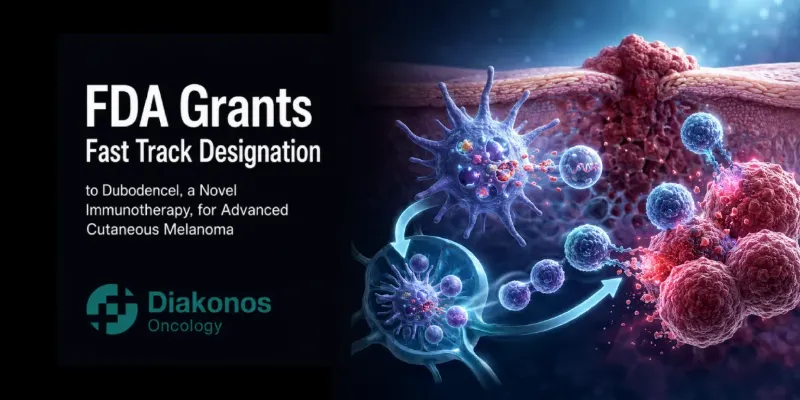
Diakonos Oncology has received Fast Track designation from the U.S. Food and Drug Administration for DOC1021, also known as dubodencel, in unresectable or metastatic cutaneous melanoma. The investigational therapy is a first-in-class, patient-derived, double-loaded dendritic cell immunotherapy designed to stimulate broad anti-tumor immune responses by using each patient’s own tumor antigen profile.
The designation applies to patients with advanced cutaneous melanoma whose disease cannot be surgically removed or has spread to distant organs. Although immune checkpoint inhibitors and targeted therapies have reshaped melanoma treatment, a substantial proportion of patients still experience primary resistance, relapse after initial response, limited durability of benefit, or treatment-limiting toxicity. This persistent unmet need continues to drive interest in new immunotherapeutic strategies capable of generating deeper and more durable immune control.
"Receiving Fast Track designation underscores the FDA's recognition of the significant unmet need that remains for patients with advanced melanoma and the potential of DOC1021 to address this challenge," said Jay Hartenbach, President and Chief Operating Officer of Diakonos Oncology. “This designation supports our ongoing clinical development efforts and reflects the promise of DOC1021's novel approach, which leverages a patient's full complement of tumor antigens to drive meaningful anti-tumor immune responses.”
Fast Track designation is intended to facilitate the development and review of investigational therapies that address serious conditions and unmet medical needs. For Diakonos, the regulatory milestone supports continued clinical development of DOC1021 in refractory melanoma, including an ongoing Phase 1/2 trial that is currently recruiting patients.
DOC1021 is manufactured using a patient’s dendritic cells together with tumor lysate and amplified tumor-derived mRNA prepared from freshly obtained tumor specimens. This “double-loading” strategy is intended to expose the immune system to a broad pool of tumor antigens, rather than focusing on a single predefined target. According to the company, the approach is designed to mimic aspects of viral infection and promote a more comprehensive tumor-directed immune response.
A notable feature of the platform is that it does not require genetic engineering or molecular modification of the patient’s immune cells. It also does not require preconditioning chemotherapy or high-dose interleukin-2 administration. Diakonos says DOC1021 is being developed for outpatient use and potential delivery through community cancer centers, which may be important if future studies confirm clinical benefit and safety.
The company is currently evaluating DOC1021 across three actively enrolling clinical programs: a Phase 1 study in pancreatic cancer, a Phase 2 study in glioblastoma, and a Phase 1/2 study in refractory melanoma. The melanoma trial is supported by the Cancer Prevention and Research Institute of Texas. DOC1021 has now received FDA Fast Track designation for pancreatic cancer, glioblastoma, and unresectable or metastatic cutaneous melanoma. The glioblastoma program also received Orphan Drug Designation in January 2024.



Comments
No Comments Yet!