New PHERGain and PHERGain-2 data presented at #ESMObreast26 strengthen the rationale for chemotherapy de-escalation in selected patients with early HER2+ breast cancer.
PHERGain showed that about one-third of patients avoided chemotherapy, with nearly 90% remaining relapse-free five years after surgery.
In PHERGain-2, 59.6% achieved pCR after chemotherapy-free trastuzumab-pertuzumab, while quality of life was largely preserved.
New data from the PHERGain and PHERGain-2 studies strengthen the case for chemotherapy de-escalation in carefully selected patients with HER2-positive early breast cancer. Presented at ESMO Breast Cancer 2026, the findings suggest that response-adapted strategies using HER2-targeted therapy may allow a substantial proportion of patients to avoid cytotoxic chemotherapy while preserving disease control and health-related quality of life.
The results are clinically relevant because HER2-positive breast cancer, once considered an aggressive subtype, now has highly effective systemic treatment options. The challenge is no longer only how to intensify therapy for high-risk disease, but also how to identify patients with a high likelihood of cure who may be safely spared avoidable toxicity.
As Dr Giampaolo Bianchini of IRCCS Ospedale San Raffaele, Milan, noted: “Current treatments for HER2-positive breast cancer are extremely effective, but it is important that patients with a high likelihood of cure only receive systemic treatment necessary to maximise benefit while minimising toxicity.”
PHERGain is an international, multicenter phase II study that enrolled 356 patients across 45 hospitals in seven European countries. The trial evaluated a chemotherapy de-escalation strategy in stage I–IIIA, operable HER2-positive breast cancer using early metabolic response on FDG-PET and pathological complete response, pCR, to guide subsequent therapy.
Patients initially received chemotherapy-free neoadjuvant trastuzumab plus pertuzumab, with or without endocrine therapy where appropriate. PET responders continued the chemotherapy-free regimen, while non-responders were switched to chemotherapy plus trastuzumab and pertuzumab. Postoperative treatment was then adapted according to pCR status.
Earlier results, published in The Lancet, showed that approximately one-third of patients could omit chemotherapy, with a 3-year invasive disease-free survival rate of 94.8%. Updated five-year outcomes presented at ESMO Breast Cancer 2026 now confirm the durability of this approach, with close to 90% of patients remaining free from relapse five years after surgery.
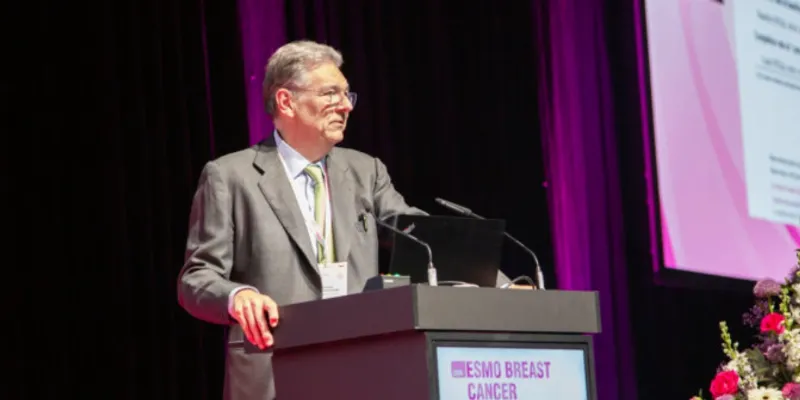
Dr Javier Cortés, principal investigator of PHERGain and Director of the International Breast Cancer Center in Madrid, emphasized the clinical and translational implications: “In addition to the clinical outcomes, with nearly 90% of patients free from relapse five years after surgery, we see that the analysis of circulating tumor DNA in blood is emerging as a key tool to enable early identification of patients with a better prognosis and those who may benefit from more intensive treatment.”
Dr Javier Cortés
The circulating tumor DNA analysis is important because treatment de-escalation will ultimately depend on more accurate risk stratification. Liquid biopsy may help distinguish patients likely to remain disease-free from those who require escalation, although prospective validation remains essential.
PHERGain-2: pCR-guided chemotherapy-free strategy in low-risk disease
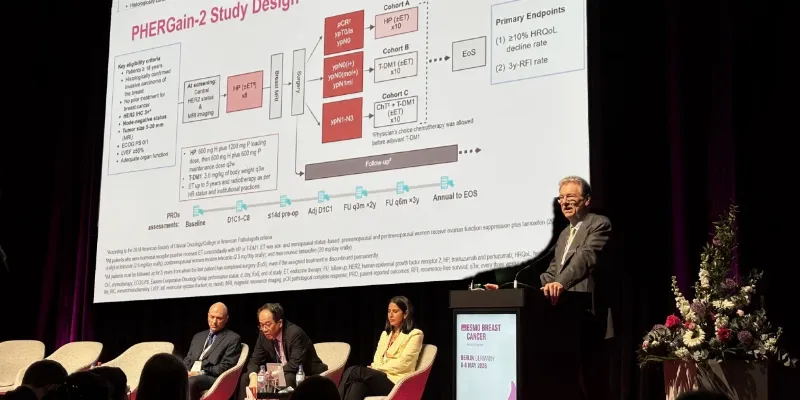
PHERGain-2 moves the concept further by testing a chemotherapy-free, pCR-guided approach in a more selected population. The international, multicenter, single-arm, open-label phase II trial enrolled 396 patients with untreated, centrally confirmed HER2-positive, IHC 3+, node-negative early breast cancer. Tumors measured 5–30 mm by central MRI. The study was conducted across 47 centers in Spain, Italy, Denmark, Hungary, Poland, and Bulgaria.
All patients received neoadjuvant subcutaneous trastuzumab and pertuzumab every three weeks for eight cycles. After surgery, adjuvant therapy was adapted according to pathological response. Patients with pCR, defined as ypT0/is, ypN0, continued trastuzumab and pertuzumab to complete 18 cycles. Patients with residual invasive disease in the breast or limited nodal findings received T-DM1 for 10 cycles. Those with ypN1–3 disease could receive optional adjuvant chemotherapy before T-DM1. Patients with hormone receptor-positive disease also received endocrine therapy during both neoadjuvant and adjuvant phases.
Figure. In the PHERGain-2 study of patients with HER2-positive early breast cancer, patients who achieved pCR at 1 year following treatment with neoadjuvant trastuzumab–pertuzumab had a lower incidence of decline in HRQoL of ≥10% compared with patients who did not achieve pCR (ESMO Breast Cancer 2026, Abstract 214O)
Of the 396 enrolled patients, 391, 98.7%, underwent surgery. Median tumor size was 18 mm, and 72.7% had hormone receptor-positive tumors. T1 disease was present in 61.6% of patients. A pCR was achieved in 236 patients, 59.6%, allowing them to continue chemotherapy-free adjuvant trastuzumab and pertuzumab. Among patients with residual disease, 148, 37.8%, entered the T-DM1 cohort, and seven, 1.8%, entered the cohort in which optional chemotherapy could be considered.
Bianchini highlighted why PHERGain-2 represents a distinct step forward: “The PHERGain-2 trial represents a further advance in that it includes a highly selected, favourable-risk population with small, node-negative tumours, and only those with cancers that were HER2 3+ by IHC, which have greater sensitivity to HER2-targeted agents. This is very reassuring for patients who may have concerns relating to the efficacy of treatment in the absence of chemotherapy.”
PHERGain-2 has co-primary endpoints of 1-year health-related quality of life decline, measured by EORTC QLQ-C30, and 3-year recurrence-free interval, based on STEEP criteria. The recurrence-free survival endpoint remains immature and is still being followed.
At one year, patients who achieved pCR and continued chemotherapy-free treatment had a lower incidence of clinically meaningful HRQoL decline of at least 10% than those without pCR who received T-DM1 with or without chemotherapy, 37.3% versus 51.9%. Baseline mean global HRQoL was 78.6.
Safety was broadly consistent with expected trastuzumab, pertuzumab and T-DM1 toxicities. Any-grade treatment-related adverse events were reported in 86.6% of patients, with grade 3 events in 5.6%. Serious adverse events occurred in 6.1%. One patient, 0.3%, died from T-DM1-related pneumonitis, underscoring that de-escalation strategies still require careful monitoring, particularly when antibody-drug conjugates are used.
Dr Antonio Llombart-Cussac, principal investigator of PHERGain-2 and Head of Medical Oncology at Hospital Arnau de Vilanova in Valencia, said: “The results of PHERGain-2 reinforce the idea that it is possible to offer patients a therapeutic alternative that prioritizes quality of life by avoiding side effects that negatively impact physical and emotional well-being, such as fatigue, hair loss, or other health problems associated with chemotherapy.”
Antonio Llombart Cussac, during the Proffered Paper session 1 at the ESMO Breast Cancer 2026
Bianchini also noted the potential clinical relevance of the findings, while stressing the need for longer follow-up: “Most patients were able to avoid cytotoxic chemotherapy or antibody–drug conjugate therapy, and this was accompanied by preservation of HRQoL for the majority,” he says. “Also, the treatments are already available in the clinic and could be implemented directly once data on longer-term efficacy are reported.”
Dr Giampaolo Bianchini
Toward biomarker-driven de-escalation
The PHERGain program fits into a broader effort to reduce overtreatment in patients with small, node-negative HER2-positive breast cancer. Prior studies such as APT and ATEMPT have already shown that excellent outcomes can be achieved with reduced-intensity regimens in selected patients. Ongoing trials, including ATEMPT 2.0 and ADEPT, are further refining the role and duration of HER2-targeted therapy and antibody-drug conjugates.
For now, PHERGain-2 provides a strong signal that nearly 60% of carefully selected patients can achieve pCR after neoadjuvant trastuzumab and pertuzumab without chemotherapy. However, the key efficacy endpoint, 3-year recurrence-free interval, is still pending.
Bianchini concluded: “The implementation of a biomarker strategy could further help to select patients most likely to benefit from a pCR-guided approach, while data from the ongoing ATEMPT 2.0 trial may contribute to a clearer understanding of the optimal duration of T-DM1.”






Comments
No Comments Yet!