FDA Approves Nivolumab-AVD as First Immunotherapy Combination for Hodgkin Lymphoma
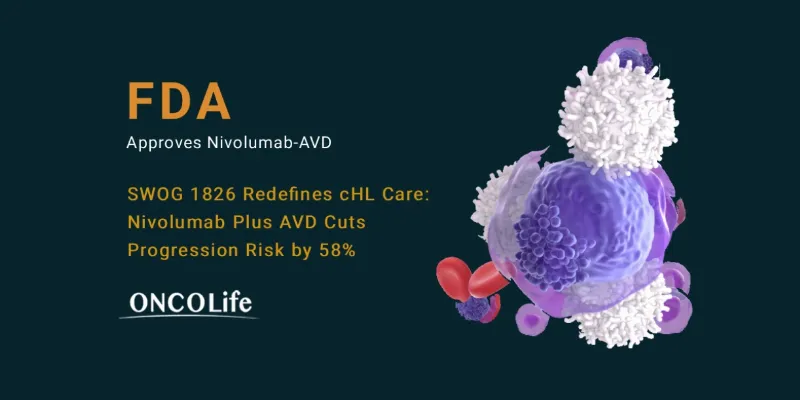
The FDA has approved nivolumab plus AVD as first-line treatment for advanced classical Hodgkin lymphoma in patients aged 12 and older. In the phase 3 SWOG 1826 trial, the regimen reduced the risk of progression or death by 58% versus BV-AVD, with sustained benefit at 36.7 months. This marks the first immunotherapy-based combination in frontline cHL, redefining treatment standards.
The U.S. Food and Drug Administration has approved nivolumab (Opdivo) in combination with doxorubicin, vinblastine, and dacarbazine for the treatment of adult and pediatric patients aged 12 years and older with previously untreated Stage III or IV classical Hodgkin lymphoma. The decision introduces the first immunotherapy-based combination regimen into the frontline setting for advanced disease, marking a notable shift in treatment strategy.
The approval is supported by data from the phase 3 SWOG 1826 trial, a randomized, open-label, multicenter study enrolling 994 patients. Participants were assigned to receive either nivolumab plus AVD or brentuximab vedotin plus AVD for six cycles. The primary endpoint, progression-free survival assessed by investigators, was significantly improved with the nivolumab-based regimen. The study demonstrated a hazard ratio of 0.42, corresponding to a 58% reduction in the risk of disease progression or death. Median progression-free survival was not reached in either arm at a median follow-up of 13.7 months.
Longer-term outcomes reinforce the durability of benefit. After a median follow-up of 36.7 months, overall survival remained immature, with 1.8% deaths in the nivolumab plus AVD arm compared with 3.4% in the comparator arm. These findings support the integration of immune checkpoint inhibition into first-line therapy for advanced classical Hodgkin lymphoma.
“For decades, treatment approaches in classical Hodgkin Lymphoma have presented significant challenges, both for newly diagnosed patients and those facing relapse,” said Dr. Alex Herrera, Chief of Division of Lymphoma, City of Hope National Medical Center. “In the U.S., the nivolumab-based combination for patients with previously untreated Stage III or IV cHL demonstrated improved progression-free survival compared with standard of care, BV-AVD. The SWOG 1826 study provides data for frontline use of this immunotherapy-based regimen.”
Safety data were consistent with the known profile of nivolumab. Serious adverse reactions occurred in 39% of patients receiving the combination, while immune-mediated adverse events were reported in 9%, including 2.7% grade 3 or 4 events. Known risks include pneumonitis, colitis, hepatitis, endocrinopathies, nephritis, dermatologic toxicity, infusion-related reactions, and complications related to hematopoietic stem cell transplantation. Careful monitoring remains essential in clinical practice.
“These approvals represent a defining moment for people living with classical Hodgkin Lymphoma,” said Monica Shaw, MD, Senior Vice President of Oncology Commercialization. “In the U.S., we are particularly proud that Opdivo in combination with AVD now stands as an immunotherapy combination available for adults and pediatric patients, ages 12 and older, with previously untreated advanced disease. Concurrently, in the EU, Opdivo in combination with brentuximab vedotin has also achieved a milestone as the first immunotherapy combination for certain relapsed or refractory patients.”
The FDA also converted nivolumab’s prior accelerated approvals into full approvals for adult patients with relapsed or refractory disease following autologous hematopoietic stem cell transplantation and brentuximab vedotin, or after three or more lines of systemic therapy including transplantation. These indications were initially granted accelerated approval in 2016 and 2017.
About Nivolumab (Opdivo)
Nivolumab is a PD-1 immune checkpoint inhibitor that enhances the body’s immune response against cancer, becoming a key therapy across multiple tumor types. Developed by Bristol Myers Squibb, its extensive clinical program has enrolled over 35,000 patients across all trial phases. Research has advanced understanding of biomarkers, particularly PD-L1, in predicting treatment benefit. First approved in 2014, Opdivo is now authorized in more than 65 countries. Its combination with Yervoy marked the first approved immuno-oncology regimen for metastatic melanoma in 2015, and is currently approved in over 50 countries worldwide.

Comments
No Comments Yet!