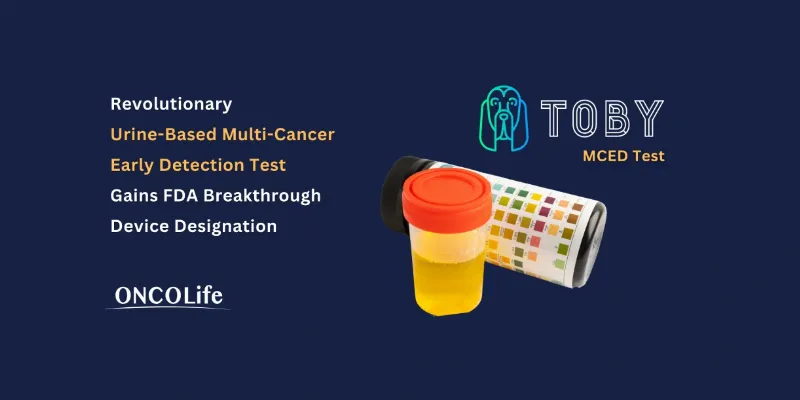
FDA Grants Breakthrough Status to First Urine-Based Multi-Cancer Early Detection Test
16 April 2026
Key Takeaways
- TOBY’s urine-based MCED test received FDA Breakthrough Device Designation.
- It is the first urine-based MCED platform granted this status.
- The test analyzes urinary VOCs using spectroscopy and machine learning from a single sample.
- The designation may accelerate clinical validation, regulatory progress, reimbursement, and broader screening access.
TOBY announced that the U.S. Food and Drug Administration, FDA, has granted Breakthrough Device Designation to its urine-based multi-cancer early detection, MCED, test, marking a notable step for non-invasive cancer screening. The designation is intended for technologies that may offer more effective diagnosis or treatment of serious diseases and could help accelerate development and regulatory review.
How the Urine-Based MCED Platform Works
The company’s platform is designed to detect cancer-associated molecular patterns in urine by analyzing volatile organic compounds, or VOCs, with spectroscopy and machine learning. Unlike blood-based approaches, the test uses a single urine sample, an approach that could make cancer screening simpler, more accessible, and easier to scale across broader populations.
FDA Recognition Signals Regulatory Momentum
"This Breakthrough Device Designation marks a defining moment for TOBY and for the future of cancer screening," said Matthew Laskowski, Chief Executive Officer of TOBY. “It reinforces our conviction that urine-based, non-invasive detection can fundamentally change how and when cancer is identified, not just by improving the patient experience, but by enabling screening to happen earlier and at scale. We believe the next generation of cancer detection will be built around approaches that are simple, accessible, and designed for broad population use, rather than constrained by the limitations of existing modalities, and our platform is engineered with that vision in mind, supporting multi-cancer detection from a single sample.”
What a Non-Invasive MCED Test Could Mean for Screening
TOBY says the platform is the first urine-based MCED technology to receive Breakthrough Device Designation. The recognition also builds on an earlier FDA Breakthrough Device Designation for the company’s urine-based bladder cancer test, suggesting continued regulatory momentum for its broader urine-based oncology portfolio.
Clinical Validation for Broad Adoption
For clinicians and health systems, the promise of a urine-based MCED approach lies not only in convenience, but also in the possibility of expanding screening reach beyond current modality-specific limitations. A single-sample platform capable of detecting multiple cancers could eventually support wider population screening, although further validation will be needed before routine clinical use.
"The FDA reserves Breakthrough Device Designation for platforms that can fundamentally change patient outcomes, not incremental improvements on what already exists," said Matthew Collier, Chief Executive Officer of TOBY Oncology. “A single, non-invasive urine sample that aims to deliver on the necessary early stage accuracy, improved affordability and broadly available accessibility to enable screening for many cancers is exactly that kind of platform, and this designation accelerates our path to the patients and health systems that need it most.”
The company said the designation will support expanded clinical studies, future regulatory submissions, and reimbursement efforts. The next key step will be generating the clinical evidence needed to show that the test can deliver reliable early-stage detection performance across multiple tumor types and support broad adoption in practice.


Comments
No Comments Yet!