FDA Grants Breakthrough Status to WU-CART-007 for T-Cell Leukemias and Lymphomas
1 April 2026
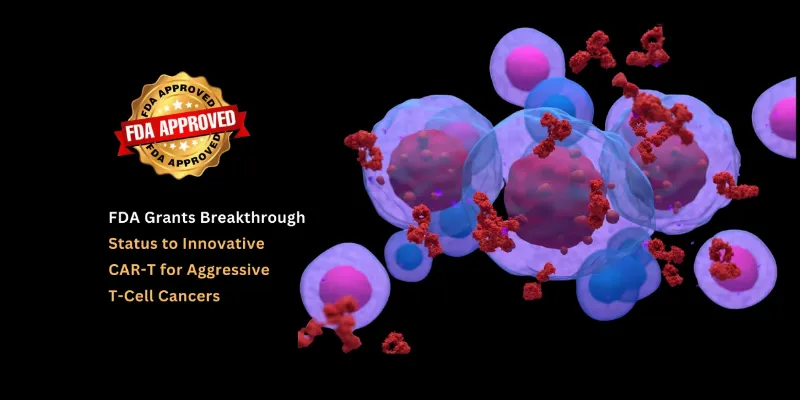
FDA has granted Breakthrough Therapy designation to WU-CART-007, an off-the-shelf CAR-T therapy for relapsed or refractory T-ALL and T-LL, two aggressive T-cell cancers with poor outcomes. In a phase 1 study, the therapy achieved a 91% overall response rate and 72.7% complete remission rate among evaluable patients, supporting its potential to bridge more patients to curative stem cell transplantation.
A novel CAR-T cell therapy developed at Washington University School of Medicine in St. Louis has received Breakthrough Therapy designation from the U.S. Food and Drug Administration, marking an important regulatory step for a treatment aimed at some of the most difficult-to-treat T-cell malignancies. The investigational therapy, WU-CART-007, also known as soficabtagene geleucel, is licensed to Wugen, a WashU Medicine startup biotech company.
The therapy is being developed for relapsed or refractory T-cell acute lymphoblastic leukemia, T-ALL, and T-cell lymphoblastic lymphoma, T-LL, two rare but highly aggressive blood cancers with limited treatment options once standard therapy fails. For patients whose disease does not respond or returns after treatment, average survival is about six months, and fewer than 7% remain alive at five years.
In the phase 1 study, conducted across centers in the U.S., Australia and Europe, 28 adolescent and adult patients with heavily pretreated or treatment-resistant T-cell lymphoblastic cancers were enrolled. Among the 11 patients evaluable after treatment, the overall response rate was 91%, with 10 patients showing either no detectable cancer or a marked reduction in disease burden. Eight of the 11 patients, 72.7%, achieved complete remission. At the data cutoff, six patients who subsequently underwent stem cell transplantation remained in remission six to 12 months later, according to findings published in Blood.
“This therapy has the potential to enable long-term survival for this patient population by controlling the disease and allowing patients — who would otherwise not be eligible — to proceed to stem cell transplantation, the only potentially curative treatment for these blood cancers,” said Dr. John F. DiPersio, PhD, who developed the therapy in his laboratory at WashU Medicine. “We remain hopeful that the ongoing Phase 2 study will be completed soon, and we’ll have positive results — but we’ll need some time to see how the patients do in both short-term and long-term follow up.”
A key feature of WU-CART-007 is that it is designed as an off-the-shelf therapy. Unlike currently approved CAR-T products, which are custom-manufactured from a patient’s own immune cells over several weeks, this product is generated in advance from healthy donor cells and can be administered without that delay. For patients with rapidly progressing T-cell cancers, that shorter timeline may be clinically meaningful.
The program also addresses a major scientific hurdle unique to T-cell malignancies. Because both the therapeutic cells and the cancer cells are T cells, researchers had to engineer the product to avoid CAR-T fratricide, a self-targeting problem not seen with approved CAR-T therapies for B-cell cancers.
“This FDA Breakthrough Therapy designation for soficabtagene geleucel highlights the role of Siteman Cancer Center, a leading NCI-designated Comprehensive Cancer Center, and WashU Medicine in advancing innovative CAR-T cell therapies for aggressive T-cell leukemias and lymphomas,” said Professor Timothy J. Eberlein, MD, director of Siteman Cancer Center. “The dedicated work of our physician-scientists and clinicians is translating the most cutting-edge cellular immunotherapy research into the newest treatment options for patients with relapsed or refractory T-cell acute lymphoblastic leukemia and T-cell lymphoblastic lymphoma.”
The phase 2 trial is ongoing, with Siteman Cancer Center and Siteman Kids at St. Louis Children’s Hospital serving as key sites for the adult and pediatric portions of the study.
CAR-T therapy
Comments
No Comments Yet!