Retatrutide Receptor Pharmacology: What Lab Data Show
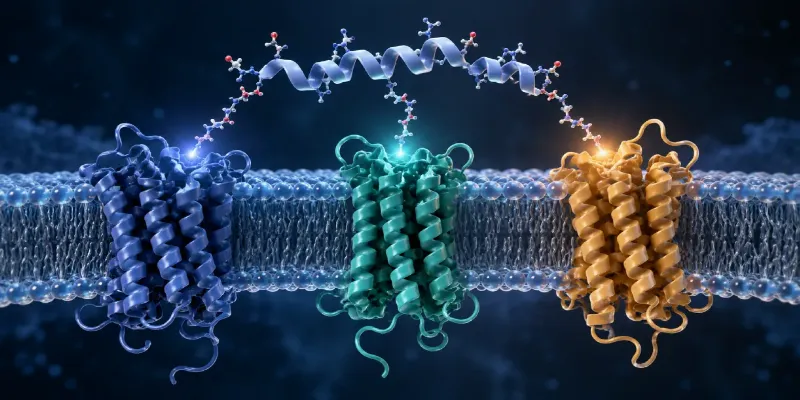
One molecule, three receptors: how retatrutide is changing incretin research
For years, scientists studied gut hormone receptors one at a time. To see why that matters, it helps to know what a receptor is. Think of it as a lock on the surface of a cell. When the right molecule fits into it, the cell gets a signal and responds. A molecule that switches a receptor on is called an agonist.
The first drugs in this field switched on just one receptor, the GLP-1 receptor. Then came molecules that worked on two at once, adding the GIP receptor. Now researchers face something more complicated: a single peptide designed to switch on three related receptors together.
Retatrutide (LY3437943), developed by Eli Lilly, is the best-studied example so far. News coverage usually focuses on its clinical trials. For lab scientists, the more interesting question is simpler. How do you work out what a molecule does when it acts on three different receptors: the GIP receptor (GIPR), the GLP-1 receptor (GLP-1R) and the glucagon receptor (GCGR)?
From single targets to triple agonists
The idea behind retatrutide builds on what was already known about glucagon.
Glucagon is a hormone that helps the body burn more energy and break down fat. The problem is that it also raises blood sugar. Scientists came up with a way around this. If the same molecule also activates GIPR and GLP-1R, which help release insulin, the rise in blood sugar should be balanced out, while glucagon’s effect on energy and fat stays.
In mice, this balance worked. In glucose tolerance tests, which measure how quickly the body clears sugar from the blood, the effects of GIPR and GLP-1R were stronger than the effect of GCGR. These are animal results, so they don’t tell us what would happen in people.
What lab tests show about strength at each receptor
The receptor-by-receptor data come mainly from a single study published in 2022.
The researchers worked with HEK-293 cells, a human cell line widely used in lab research. Each batch of cells was engineered to carry only one of the three receptors, so any response could be traced to that receptor alone. To read the response, they measured cAMP. Cells produce this small messenger molecule when one of these receptors is switched on, so a rise in cAMP shows the receptor is sending a signal. The team picked cell lines with a fairly low number of receptors. Cells packed with receptors tend to boost even a weak signal, which can make a molecule look stronger than it really is. Using leaner cells kept the measurements closer to the molecule’s true activity.
To compare strength, scientists use a number called EC50. It is the concentration needed to reach half of the maximum effect. The lower the EC50, the stronger the molecule.
At all three receptors, retatrutide produced a full response, the same maximum effect as the natural hormone. The difference was in how much of it was needed. The authors described the profile as fairly balanced between the glucagon and GLP-1 receptors, with the GIP receptor clearly in the lead.
The team also tested cells closer to real tissue. In lab-grown liver cells, which mostly carry the glucagon receptor, retatrutide made the cells release glucose about as well as glucagon itself. In fat cells, it was better than natural GIP at triggering fat breakdown.
It’s worth remembering that these results come from the company that developed the molecule. EC50 values can also differ between labs depending on the cells and methods used.
Separating the three effects in living animals
Figuring out which receptor is responsible for which effect in a living animal is much harder than in a dish of cells.
The researchers solved this using genetically modified mice. To see what the glucagon receptor does on its own, they used mice that lack the GLP-1 receptor. A day before the test, they also gave these mice an antibody that blocks the GIP receptor. That left the glucagon receptor as the only one that could respond.
Other experiments showed that blood sugar control improved through either the GIP or the GLP-1 receptor. In obese mice, the extra energy burning came from the glucagon receptor.
The takeaway for anyone studying molecules like this is simple. If an animal shows an effect, you can’t credit it to one receptor until the others have been switched off.
Beyond signal strength: bias and occupancy
cAMP levels only show one part of what happens when a receptor is switched on.
When a receptor is activated, the cell can respond through more than one pathway. One produces cAMP. Another recruits a protein called β-arrestin, which helps pull the receptor inside the cell and dial the signal down. A molecule that favours one pathway over another is said to show “bias”.
Tirzepatide acts on two of the same receptors, and studies of it give a good idea of what else can be measured. In a 2020 study, researchers came up with a way to estimate what share of each receptor type tirzepatide occupies. By that estimate, it engaged the GIP receptor more than the GLP-1 receptor. At the GLP-1 receptor it leaned towards producing cAMP rather than recruiting β-arrestin, and it pulled fewer receptors inside the cell than natural GLP-1 did. The team also looked at pancreatic islets, the clusters of cells that produce insulin. There, β-arrestin weakened the insulin response to GLP-1, but the response to tirzepatide was unaffected.
These findings are about tirzepatide and can’t simply be assumed for retatrutide. But the same questions apply. Which pathway does retatrutide favour at each receptor? How quickly are the receptors pulled into the cell? How is the molecule spread across the three targets? Nobody has fully answered these yet, and answering them needs carefully controlled cell systems and a test compound you can trust.
Why the quality of the sample matters
Look again at the table.
At the GIP receptor, retatrutide works at a concentration roughly 90 times lower than at the glucagon receptor, based on the published values. With such a wide range, small problems with a sample can make a big difference. If a vial contains less peptide than the label says, every result shifts, because the real concentration in the test is lower than the lab thinks. If part of the sample has broken down, and the breakdown products still act on one receptor but not another, the apparent balance between receptors could change too. Two labs could study “the same” molecule and reach different conclusions just because their samples were different.
This is why the starting material deserves as much attention as the assay design. When a lab looks at sources of RETA peptide for sale for cell or animal work, the checks follow directly from the risks described above. Mass spectrometry results in the batch certificate of analysis confirm that the molecule is the right one. HPLC shows how pure the sample is and how much of it may be impurities or breakdown products, which are the very things that can distort the balance between receptors. A research-use-only label confirms that the material is intended for laboratory studies.
Recording the batch number next to every experiment makes it possible to tell later whether a change in results came from the biology or from a new batch.
Legal status and research-only use
Retatrutide is still an experimental compound and has not been approved anywhere.
Its late-stage (Phase 3) trials, including TRIUMPH-2 and TRIUMPH-3, are still part of the clinical development programme. Eli Lilly states that retatrutide cannot be legally sold or marketed for human use. The company plans to apply for FDA approval in the first quarter of 2027.
This puts clear limits on lab work. Research-grade material is meant only for cell-based and animal studies. It is not for use in people or animals outside research, and not for diagnosing or treating any condition.
What comes next
Retatrutide has turned an idea into a working example.
The published data show how far one peptide can be tuned to act on three related receptors. What’s still unclear is which signalling pathways it favours, how it is spread across its targets and what each receptor contributes. Independent labs are well placed to answer these questions, as long as the compound they start with has been properly tested.
Sources:
- . Coskun T, Urva S, Roell WC, et al. LY3437943, a novel triple glucagon, GIP, and GLP-1 receptor agonist for glycemic control and weight loss: From discovery to clinical proof of concept. Cell Metabolism, 2022;34(9):1234–1247.e9.
- Willard FS, Douros JD, Gabe MBN, et al. Tirzepatide is an imbalanced and biased dual GIP and GLP-1 receptor agonist. JCI Insight, 2020;5(17):e140532.
- Jakubowska A, le Roux CW, Viljoen A. The road towards triple agonists: glucagon-like peptide 1, glucose-dependent insulinotropic polypeptide and glucagon receptor – an update. Endocrinology and Metabolism (Seoul), 2024;39(1):12–22.
- ClinicalTrials.gov – A Study of Retatrutide (LY3437943) in Participants With Type 2 Diabetes Mellitus Who Have Obesity or Overweight (TRIUMPH-2).
- ClinicalTrials.gov – A Study of Retatrutide (LY3437943) in Participants With Obesity and Cardiovascular Disease (TRIUMPH-3).
- Eli Lilly and Company – Lilly’s triple agonist, retatrutide, successful in two additional Phase 3 obesity trials, delivering significant improvements in weight and A1C (press release, 23 July 2026).





Comments
No Comments Yet!