Sacituzumab Tirumotecan Extends Overall Survival by 7 Months in Advanced Endometrial Cancer
26 October 2026
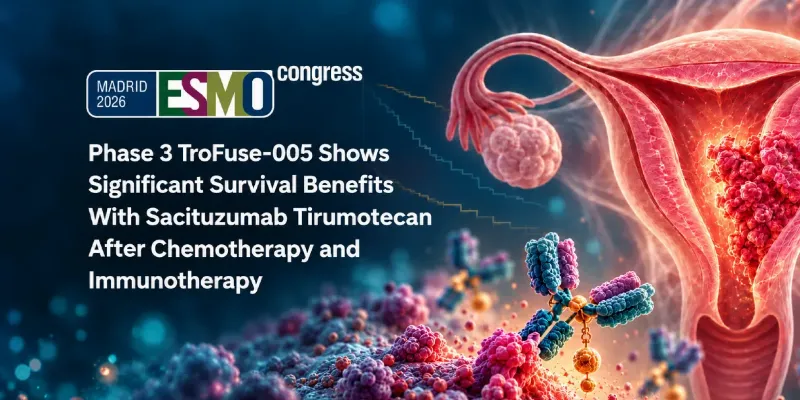
Presented at ESMO Congress 2026, the Phase 3 TroFuse-005 trial showed that sacituzumab tirumotecan (sac-TMT) extended median overall survival to 19.0 months versus 12.1 months with chemotherapy in advanced or recurrent endometrial cancer. The TROP2-directed ADC reduced the hazard of death by 32% and progression or death by 41% in patients previously treated with platinum-based chemotherapy and PD-1/PD-L1 immunotherapy. Objective response rates doubled, although severe treatment-related adverse events were more frequent.
The findings of the trial, presented at the European Society for Medical Oncology (ESMO) Congress 2026 and simultaneously published in The Lancet, suggest a potentially important new treatment option for patients with limited therapeutic alternatives.
Sacituzumab tirumotecan (sac-TMT), an investigational TROP2-directed antibody-drug conjugate (ADC), significantly improved overall survival (OS) and progression-free survival (PFS) in patients with advanced or recurrent endometrial cancer who had previously received platinum-based chemotherapy and anti-PD-1/PD-L1 immunotherapy.
Overall Survival Improved by 6.9 Months
- At a prespecified interim analysis, following a median of 14 months, sac-TMT reduced the hazard of death by 32% compared with physician's choice of chemotherapy.
- Median OS reached 19.0 months with sac-TMT versus 12.1 months with chemotherapy, representing an absolute improvement of 6.9 months.
- The benefit extended to disease control. Median PFS was 7.2 months in the sac-TMT group compared with 3.9 months in the chemotherapy group, corresponding to a 41% reduction in the hazard of progression or death.
- These findings are particularly relevant because patients whose endometrial cancer progresses after platinum-based chemotherapy and immunotherapy have few effective treatment options and generally face a poor prognosis.
Response Rates Doubled With Sac-TMT
The survival advantage was accompanied by improved tumor responses. The objective response rate (ORR) was 35.1% with sac-TMT compared with 17.3% with chemotherapy, an absolute difference of 17.8 percentage points (P<0.00001). Complete responses occurred in 6.1% and 4.5% of patients, respectively. Responses were also more durable. Median duration of response reached 11.1 months with sac-TMT versus 6.9 months with chemotherapy.
“Sac-TMT is the first TROP2 ADC to demonstrate an improvement in overall survival in advanced or recurrent endometrial cancer in this setting compared to chemotherapy in a global Phase 3 trial. In addition, TroFuse-005 found a higher response rate and longer duration of response among patients treated with sac-TMT compared to chemotherapy,” said Dr. Domenica Lorusso, the study’s global lead investigator, and professor of Obstetrics and Gynecology at Humanitas University in Milan. “The incidence and mortality rates of endometrial cancer are increasing worldwide, and the results from TroFuse-005 have the potential to change the way we treat patients who have received prior platinum-based chemotherapy and anti-PD-1/L1 immunotherapy.”
Trial Design and Patient Population
TroFuse-005 (NCT06132958) was a randomized, open-label, multicenter Phase 3 trial involving 776 patients with advanced or recurrent endometrial cancer previously treated with platinum-based chemotherapy and anti-PD-1/PD-L1 immunotherapy, administered either together or separately. Patients were randomly assigned to receive sac-TMT (n=386) or physician's choice of doxorubicin or paclitaxel (n=390). Sac-TMT was administered intravenously at 4 mg/kg every two weeks. The trial's dual primary endpoints were OS and PFS, with disease progression assessed by blinded independent central review.
Sac-TMT targets TROP2, a cell-surface protein overexpressed in several malignancies. The ADC delivers a belotecan-derived topoisomerase I inhibitor through a bifunctional linker designed to enhance drug delivery to tumor cells while limiting premature payload release.
Safety: Higher Rates of Severe Adverse Events
Although sac-TMT improved efficacy outcomes, treatment-related toxicity was more frequent than with conventional chemotherapy.
Treatment-related adverse events (TRAEs) of any grade occurred in 97.1% of patients receiving sac-TMT versus 89.6% receiving chemotherapy.
Grade 3 or higher TRAEs were reported in 54.4% and 41.4% of patients, respectively. The most common severe events associated with sac-TMT were:
- Anemia: 23.7%
- Neutropenia: 20.1%
- Oral mucositis/stomatitis: 9.9%
Despite the higher incidence of severe toxicity, treatment discontinuation due to adverse events remained relatively uncommon, occurring in 3.1% of patients receiving sac-TMT and 4.9% receiving chemotherapy. Treatment-related deaths occurred in three patients (0.8%) in each treatment group. No new safety signals were identified, and health-related quality of life was reportedly maintained during sac-TMT treatment.
FDA Grants Priority Review
Based on the TroFuse-005 results, the US Food and Drug Administration (FDA) has accepted a Biologics License Application for sac-TMT under priority review. The application covers adults with endometrial cancer previously treated with platinum-containing chemotherapy and a PD-1 or PD-L1 inhibitor, administered separately or in combination. The FDA has set June 15, 2027, as its target decision date.
Developed by Merck in collaboration with Kelun-Biotech, sac-TMT is also being investigated across 18 ongoing global Phase 3 trials involving multiple tumor types, including breast, ovarian, cervical, bladder and lung cancers.
A Potential Shift in Treatment Practice
TroFuse-005 is the first global Phase 3 study of a TROP2-directed ADC to demonstrate statistically significant improvements in both OS and PFS over chemotherapy in this previously treated endometrial cancer population. If approved, sac-TMT could become an important addition to the treatment landscape for advanced or recurrent endometrial cancer after platinum-based chemotherapy and immunotherapy.


Comments
No Comments Yet!