Targeted Bladder Cancer Therapy Erda-iDRS Achieves 89% Response Rate and PDC
15 March 2026
Phase 1 data show that Erda-iDRS, an intravesical erdafitinib delivery system, achieved an 89% complete response rate in FGFR-altered intermediate-risk non–muscle-invasive bladder cancer, with a median response duration of 18 months. In high-risk disease, median recurrence-free survival reached 20 months. The therapy demonstrated a tolerable safety profile, with predominantly local adverse events.
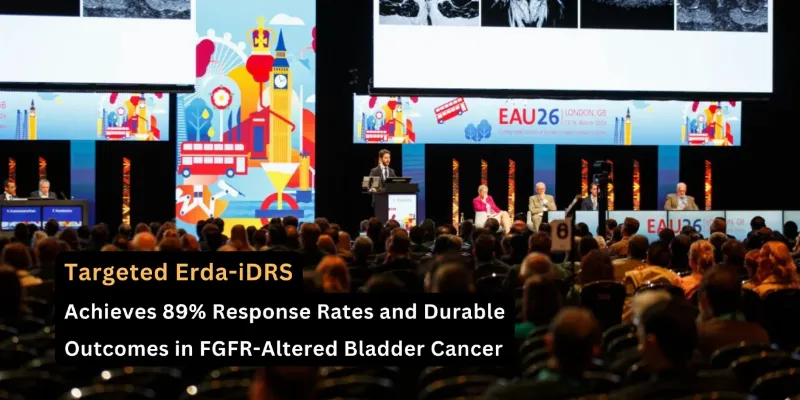
Johnson & Johnson has reported encouraging first-in-human results for Erda-iDRS, an investigational intravesical drug-releasing system delivering erdafitinib, in patients with non–muscle-invasive bladder cancer (NMIBC) harboring fibroblast growth factor receptor (FGFR) alterations. The Phase 1 data, presented at the European Association of Urology (EAU) 2026 Annual Meeting, suggest this localized targeted approach may address a long-standing gap in early-stage bladder cancer treatment.
Targeting FGFR Alterations in Early Disease
FGFR alterations are common in NMIBC, occurring in approximately 70% of intermediate-risk and 40% of high-risk tumors. These molecular changes are known drivers of tumor growth, making them a rational therapeutic target.
Erda-iDRS is designed to deliver sustained levels of erdafitinib directly into the bladder over a three-month period. This intravesical approach aims to maximize local drug exposure while minimizing systemic toxicity, a limitation often associated with oral FGFR inhibitors.
High Complete Response Rates
The open-label, multicenter Phase 1 study enrolled patients with recurrent intermediate- and high-risk NMIBC harboring FGFR alterations. Among 62 patients with intermediate-risk disease, Erda-iDRS demonstrated a complete response rate of 89% (95% CI, 78–95).
Responses were not only frequent but also durable. The median duration of complete response reached 18 months (95% CI, 14–25), with a median follow-up of 18 months. Nearly half of the patients, 49%, remain under follow-up, suggesting sustained clinical benefit.
“Intermediate-risk non–muscle-invasive bladder cancer is defined by recurrences, and many patients undergo repeated procedures as their tumors return,” said Dr. Antoni Vilaseca Cabo, adjunct physician of the Urology Service at Hospital Clínic de Barcelona, and presenting author. “In this study, treatment with Erda-iDRS led most patients with FGFR-altered disease to achieve a complete response by the end of the second treatment cycle, and many of those responses were sustained over time. Achieving and maintaining a complete response is particularly meaningful in this setting, where recurrence is common and requires repeated surgical intervention.”
Encouraging Recurrence-Free Survival
In the high-risk cohort, which included 26 patients with prior Bacillus Calmette-Guérin (BCG) exposure, the median recurrence-free survival reached 20 months (95% CI, 15–30). The 12-month recurrence-free survival rate was 83% (95% CI, 62–93), with a median follow-up of 24 months. These findings suggest potential activity even in more challenging, previously treated populations.
Favorable Safety Profile
Treatment with Erda-iDRS was generally well tolerated. No dose-limiting toxicities were reported, and most adverse events were localized. The most common treatment-related adverse events were hematuria (32%) and dysuria (22%).
Grade 3 or higher adverse events occurred in 5% of patients, while 9% discontinued treatment due to adverse events. Importantly, pharmacokinetic analyses showed prolonged drug presence in urine with limited systemic exposure, and no cases of hyperphosphatemia were observed, a known class effect of systemic FGFR inhibition.
Moving Toward Precision Therapy
“For patients with FGFR-altered non–muscle-invasive bladder cancer, care has historically not been guided by precision‑based approaches,” said Dr. Christopher Cutie, Vice President, Disease Area Leader, Bladder Cancer, Johnson & Johnson. “The high and durable complete responses demonstrated with Erda-iDRS highlight the opportunity to deliver a targeted therapy to these patients. Bringing a biology-based approach into earlier stages of this disease has the potential to change how these patients are treated.”
The ongoing MoonRISe clinical program, including Phase 2 and Phase 3 trials, is further evaluating Erda-iDRS across intermediate- and high-risk settings, both as an adjuvant and ablative strategy.
About Erdafitinib Intravesical Drug-Releasing System (Erda-iDRS)
Erda-iDRS is an investigational intravesical drug delivery system designed to deliver prolonged, localized erdafitinib, an oral kinase inhibitor, directly to the bladder. The safety and efficacy of Erda-iDRS are being evaluated in a Phase 1 study in patients with non–muscle-invasive bladder cancer (NMIBC), including those with high-risk, BCG-unresponsive disease and intermediate-risk disease with visible tumors. Additional Phase 2 and Phase 3 studies are ongoing to further assess Erda-iDRS across intermediate- and high-risk NMIBC. In 2008, Janssen Pharmaceuticals entered into an exclusive worldwide license and collaboration agreement with Astex Pharmaceuticals to develop and commercialize erdafitinib.



Comments
No Comments Yet!