AI Models Outperform Traditional Methods in Multicancer Risk Prediction
Key Takeaways
- Presented at ESMO Congress 2026, researchers developed approximately 500 machine-learning models using data from 463 K UK Biobank participants to assess risk across 20 cancers. Models outperformed conventional methods, achieving a 15-year AUROC of 0.83 for a combined cancer outcome. Performance was strongest for lung, esophageal, and liver cancers.
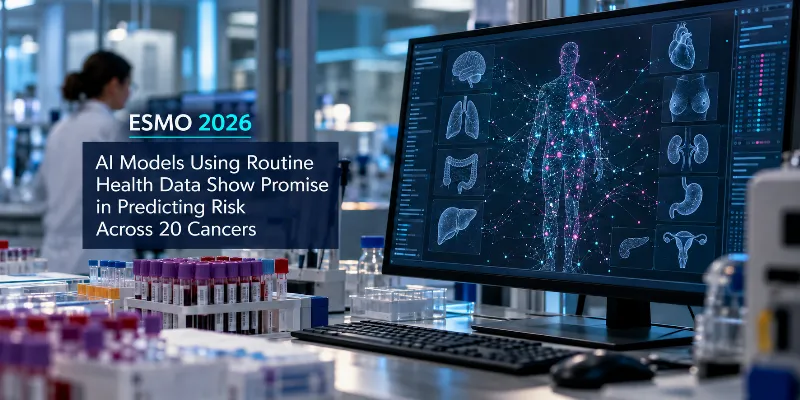
An international study presented at the ESMO Congress 2026 suggests that machine-learning models using routine clinical data could help identify individuals at increased risk of several common cancers, potentially improving targeted screening and prevention strategies.
Machine-learning models analyzing routine blood tests, medical histories, and lifestyle factors outperformed traditional statistical approaches in predicting the risk of several cancers, according to research presented at the ESMO Congress 2026. The findings were particularly promising for lung, esophageal, and liver cancers, although predictive performance varied considerably across tumor types.
AI Predicts Cancer Risk Years Before Diagnosis
The study suggests that information already available in electronic health records could support more personalized cancer risk assessment without routinely requiring expensive genetic or molecular testing. However, prospective studies are needed to determine whether this approach can improve early detection and patient outcomes.
AI Models Trained on Nearly Half a Million Participants
Researchers led by Dr. Paul-Henry Koop of the Else Kröner Fresenius Center for Digital Health at TU Dresden, Germany, developed approximately 500 machine-learning models to assess the risk of 20 common cancers.
According to the ESMO press release, the models were trained using data from 463,620 UK Biobank participants followed for approximately 18 years. During follow-up, 57,055 participants developed cancer. The researchers analyzed demographic characteristics, lifestyle factors, medical histories, ICD-10 diagnostic codes, routine blood biomarkers, and genetic and metabolomic information.
Model performance was evaluated through cross-validation, geographic testing involving participants from Scotland and Wales, and external validation using data from 42,036 participants in the US All of Us research program and more than 3 million individuals in Japan's JMDC database. To reduce the influence of potentially undiagnosed cancers, cases identified during the first year of follow-up were excluded from relevant analyses.
Strongest Predictive Performance for Many Cancers
The machine-learning models generally performed better than conventional linear statistical methods, but their ability to distinguish individuals who would subsequently develop cancer differed substantially by tumor type. For a combined outcome comprising cancers that could be predicted using routine clinical information, the models achieved an area under the receiver operating characteristic curve (AUROC) of 0.83 at 15 years.
An AUROC of 0.83 indicates good discrimination between individuals who will and will not develop the specified outcomes, although it does not establish the accuracy of individual absolute-risk estimates. The strongest predictive signals were observed for lung, esophageal, and liver cancers. In contrast, performance was more limited for ovarian, breast, and cervical cancers.
For acute myeloid leukemia and multiple myeloma, predictive accuracy declined over longer time horizons. Researchers suggested that some short-term predictions might reflect biological changes associated with cancers already developing but not yet diagnosed.
Routine Blood Tests Provide Substantial Predictive Value
One of the study's most clinically relevant findings concerned the importance of information already collected during routine medical care. Blood biomarkers and clinical history accounted for much of the models' predictive information. Routine blood measurements retained predictive value even for cancers diagnosed more than five years after baseline assessment. By comparison, incorporating genetic and metabolomic data provided relatively small additional improvements.
The researchers also developed PRE-Screen, a software toolbox designed to help artificial intelligence agents based on large language models consistently execute the risk-prediction models. Agents using PRE-Screen performed substantially better than language models attempting cancer risk predictions without the toolbox. This finding supports the potential value of structured AI workflows, although it does not establish their clinical effectiveness.
Could AI Improve Personalized Cancer Screening?
The researchers believe machine-learning risk stratification could eventually help healthcare systems identify individuals who might benefit from more intensive surveillance or preventive interventions.
“For selected cancers, these models could serve as a low-cost pre-screening step using data already available in routine care,” said Dr. Paul-Henry Koop. “Existing screening programmes cover only certain cancers and often use broad eligibility criteria, rather than assessing each person’s individual risk. Cancer types differ substantially in their carcinogenic mechanisms and in how strongly their risk factors and precursor conditions are captured in routine data.”
Dr. Koop noted that the models could help target screening or interventions to reduce cancer risk, but cautioned that many people flagged as higher risk would not develop cancer. “A positive flag should therefore trigger minimally invasive testing first,” he said.
Such an approach could complement existing screening programs, which frequently rely on age, sex, and selected risk factors rather than comprehensive individualized risk assessments.
However, Dr. Koop cautioned that many individuals identified as high risk would never develop cancer. Consequently, positive risk assessments should initially prompt minimally invasive investigations rather than automatically triggering extensive diagnostic procedures.
Clinical Validation Remains Essential
Despite encouraging results, the study was retrospective and does not demonstrate that AI-based risk prediction leads to earlier diagnoses, reduced cancer mortality, or improved patient outcomes. Important questions remain regarding false-positive results, risk calibration, population-specific biases, and the clinical consequences of acting on model predictions.



Comments
No Comments Yet!